

As another school year ends, parents should ask an important question: Are Vermont students achieving the academic outcomes they need to succeed?
- The Mississippi Miracle
- A Question for Vermont
- Academics or Activism?
- The Role of Character in Education
- It’s Time for Greater Transparency
- Why Educational Outcomes Matter
- Title IX: A June Education Spotlight
Did your child reach their expected learning goals? Have their reading and math skills improved? What significant educational outcomes did they achieve this year?
These questions matter because the primary purpose of education is to equip students with the knowledge and skills they need to become informed, capable citizens who can contribute to a flourishing society.
The Mississippi Miracle
Have you heard about the Mississippi Miracle?
For many years, Mississippi ranked near the bottom nationally in reading performance. Today, the state ranks among the nation’s top performers in reading achievement.
How did this dramatic turnaround happen?
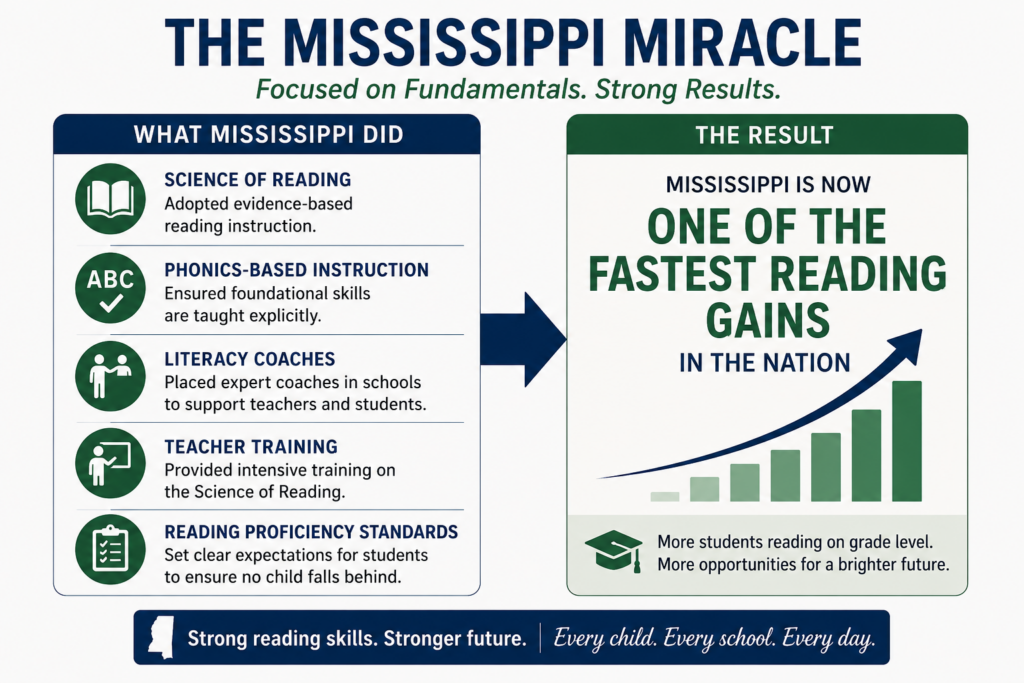
The answer was surprisingly simple. Mississippi returned to the fundamentals of literacy instruction. The state implemented phonics-based teaching grounded in the science of reading and passed the Literacy-Based Promotion Act, ensuring students could read proficiently before advancing to the next grade level.
Mississippi also invested in literacy coaches and provided teachers with training in evidence-based instructional methods.
The result has been one of the fastest academic turnarounds in the country. Other states are now adopting similar approaches, and achievement gaps are beginning to narrow.
A Question for Vermont
What about Vermont?
Will the Vermont Agency of Education consider adopting proven, cost-effective methods that improve student outcomes? Or will we continue down a path that consumes significant resources without producing stronger academic results?
What about local school boards?
Will school board members advocate for evidence-based approaches that prioritize student achievement? Will they pursue policies that help more children master reading, writing, and mathematics?
Or are current outcomes considered acceptable?
Academics or Activism?
Many students today are highly engaged in civic and political issues. Schools often celebrate student activism and participation in public discourse.
Civic engagement certainly has value. However, schools have limited instructional time. Every hour devoted to one activity is an hour unavailable for another.
The question is not whether character development matters. It does.
The question is whether academic excellence remains the primary mission of our schools.
The Role of Character in Education
A classical education recognizes that schools play a role in developing character, responsibility, and citizenship. These goals need not come at the expense of academic achievement.
Character education can be integrated into the curriculum while maintaining a strong focus on literacy, mathematics, science, history, and critical thinking.

As Noah Webster observed:
“Education, in great measure, forms the moral characters of men, and morals are the basis of government.”
Academic knowledge and moral responsibility are not competing goals. Effective schools can pursue both.
It’s Time for Greater Transparency
Parents deserve clarity regarding what is being taught in their children’s classrooms.
School districts should provide transparency concerning:
- Curriculum and instructional materials
- Academic expectations and performance standards
- Teacher evaluation systems
- Student achievement outcomes
- School policies and priorities
Communities should have access to the information necessary to evaluate whether schools are fulfilling their educational mission.
Why Educational Outcomes Matter
The ongoing strength of any society depends upon the knowledge and values passed from one generation to the next.
The purpose of education is to cultivate the skills, knowledge, and understanding necessary for individuals to become free citizens capable of participating in a complex and self-governing society.
That mission deserves our full attention.
June Education Spotlight: Title IX
SPEAK VT for Parents in Education recognizes the anniversary of Title IX, signed into law in June 1972.
Title IX was enacted to provide equal educational and athletic opportunities for women and girls and remains an important part of the conversation about fairness and opportunity in American education.

Marie Tiemann is the President of SPEAKVT for Parents in Education, a Vermont organization advocating for parents’ rights in education policy. A retired UVM business accountant with over a decade of service to the university—including roles managing $880M+ in endowments and Staff Council representation—Marie now dedicates her time to investigating, informing, and advocating for Vermont families. She recently appeared on Newsmax to discuss Vermont education policy and holds an A.A.S. in Accounting from Champlain College.